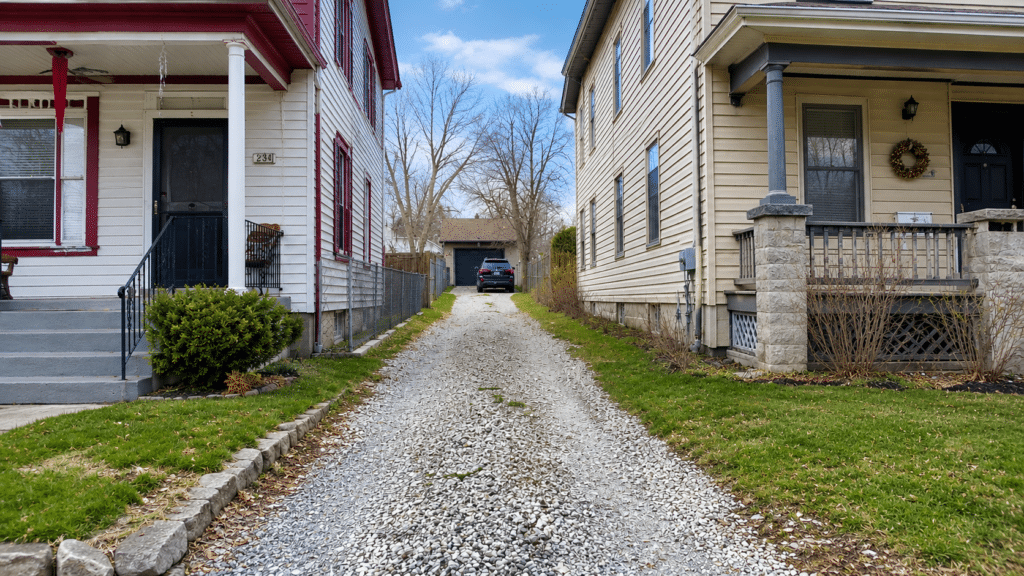
Some lawsuits collapse under the weight of their own evidence. At the centre of Albion v. Brown, 2026 ONSC 2548, lies an eight-foot strip of gravel, a right of way reserved across a Cambridge lot in 1905, before the street had seen its first automobile. Justice Ohler dismissed an application by servient owners who sought to confine their neighbours’ right of way to pedestrian use, blocked it with steel gate posts, and sued their neighbours to collect $85,000 in damages for trespass. Four years of complaints had produced a single damaged planter. The decision is a careful tour of easement interpretation principles, and a useful one for any lawyer who encounters historic rights of way on residential or commercial title.
The Dispute
The parties own adjoining historic homes in Cambridge. Since buying in 2018, the respondents have driven across an eight-foot right of way over the applicants’ backyard to reach a gravel parking area behind their home, as their predecessors did for fifteen years before them. The applicants logged years of alleged incursions, vehicles touching wooden stakes, a planter, a fence, then installed steel gate posts narrowing the entrance to 80 inches, making vehicular use impossible, and offered a “temporary” right of way through a different part of the property. They sought a declaration limiting the right of way to pedestrian access, permanent injunctions, and $50,000 in general plus $35,000 in punitive damages.
Interpreting the Grant
The 1905 grant reserved a right of way “with others” over the conveyed land toward the laneway, with no stated purpose and no limit on the means of passage. A 1973 indenture fixed the width at eight feet and confined the right to the owners of the dominant property, but again said nothing about use.
Applying the settled framework from Smith v. Morris, Fallowfield v. Bourgault, and Almel Inc. v. Halton Condominium Corp., the court construed the easement created by express grant according to a single governing principle. The grant is interpreted by its words, read in light of the circumstances surrounding its execution and the reasonable contemplation of the parties at the time the easement was created.
More specifically, the unifying thread is the primacy of the parties’ intention as fixed at the moment of the grant. Smith v. Morris lays down the foundational rule that the easement is governed by the parties’ intention at the time of the grant, judged primarily by the words used. Fallowfield carries the same idea forward, framing the nature and extent of the easement as a function of the wording read against the circumstances existing when the easement was created. Almel applies that intention-based approach to the specific problem of a general grant, holding that because the parties did not confine the use, the permitted use is not frozen but may expand within the same general nature.
The principle the court relied on runs through all three. That shared principle is exactly what led the court to conclude that the 1905 grant, silent as to purpose, could extend to modern vehicular use. The silence was not a gap to be read against the dominant land but an intentional generality. Having named no purpose and reserved the right “with others,” the original parties left the use open, and an open grant grows with the reasonable needs of the property it serves. What once carried a cart or a coal delivery now carries a car, not because the parties foresaw the automobile, but because they declined to tie the right to anything specific. Where the grant does not confine the use, the servient owner cannot confine it afterward.
Safety, Self-Created Obstacles and Damages
The applicants’ safety argument collapsed on its own evidence. The vast majority of logged “incidents” involved contact with wooden stakes the applicants themselves had planted at the very edge of the right of way, at a sharp 90-degree turn, where every other boundary feature in the laneway was set back to allow turning.
The court concluded that the navigation difficulties were caused by the applicants’ own conduct, and pointedly declined to consider incidents occurring after they obstructed the right of way with steel posts. The trespass claim fared no better. The incursions were de minimis, transitory, a matter of inches, with the only proven damage a wooden planter worth about $100, for which the respondents had offered to pay in 2019. Punitive damages were refused. Respondents who get out of their car to straighten a knocked stake and offer to pay for the damage are, in the court’s words, the antithesis of high-handed behaviour.
Takeaways for Transactional Lawyers
First, when acting on a purchase where access depends on an easement, read the actual grant, not the listing. A general grant with no stated purpose will usually support modern vehicular use, but a grant tied to a specific purpose may not, and the difference can determine whether a property has functional parking. Second, when drafting new easements or modifying old ones, specify purpose, permitted means of passage, width, maintenance obligations and snow removal. Every ambiguity in this case traces back to silence in 1905 and 1973. Third, advise servient owners that the right to use their land around an easement does not include the right to make the easement impractical. Obstruction can both defeat their own application and generate liability. Finally, counsel clients early that litigating a neighbour dispute over $145 in physical damage rarely ends well for anyone.
