Purchasers are routinely told that a pre-purchase inspection is their protection. Metti v. Kreutzer, 2026 ONSC 5238, released September 16, 2026, is a four-day trial that tests the proposition and finds it wanting. The purchasers discovered asbestos-bearing vermiculite insulation after closing, sued the vendors and the inspector, lost against the vendors entirely, won against the inspector and recovered $497.20.
The problem
The Mettis bought a century-old triplex on Maple Street in St. Catharines as an investment property, closing June 29, 2022. MDHI Home Inspection had inspected it on May 31 and reported on June 1 for a fee of $497.20. During renovations, vermiculite turned up in the ceiling and exterior walls of the upper unit and tested positive for asbestos. Removal required stripping the walls and opening the ceiling.
It was undisputed that the vermiculite predated the Mettis’ purchase, that the Kreutzers had not disclosed it and that MDHI had not reported it. There was no evidence it had been installed during the Kreutzers’ ownership (paras. 6–7).
The vendors: knowledge is the whole case
Vermiculite behind sealed walls is a latent defect. As Beatty v. Wei, 2018 ONCA 479 at para. 39, confirms, a vendor who knows of a major latent defect and conceals it may be liable. Brown v. Cassidy, 2016 ONSC 5446 at para. 84, places the onus on the purchaser to show the vendor knew of the defect, concealed it, or made representations with reckless disregard for the truth.
There was no direct evidence of knowledge, so the Mettis had to build it circumstantially and by attacking the Kreutzers’ credibility. They could not. An inspection on the Kreutzers’ own 2013 purchase had found blown fibreglass and no vermiculite, removing any inference that they learned of it when they bought, and their renovations had not opened the walls or ceiling enough to expose it. Reid J. also rejected two propositions worth noting for their generality. When a leak drove water through the upper-unit ceiling and the Kreutzers bored drain holes and patched the drywall, they “were under no obligation to have investigated further into the attic on that occasion” (para. 19). And they were “under no obligation to inquire from their tenants or former tenants” whether anyone knew of vermiculite, including from before their time (para. 23).
A building permit discrepancy also failed to dent their credibility. The permit for the main-floor front bedroom, which is not beneath the upper unit, contemplated removing drywall and insulation from its exterior walls. The Kreutzers found hard wallboard adhered directly to brick, built out studs and insulated over it instead, and the City inspected and closed the permit. Mr. Kreutzer’s later use of “reinsulate” for the walls as well as the ceiling and floor was “inaccurate in the circumstances” but “not materially misleading” (para. 35). The claim against the vendors was dismissed.
The inspector: compliant work, misdescribed credentials
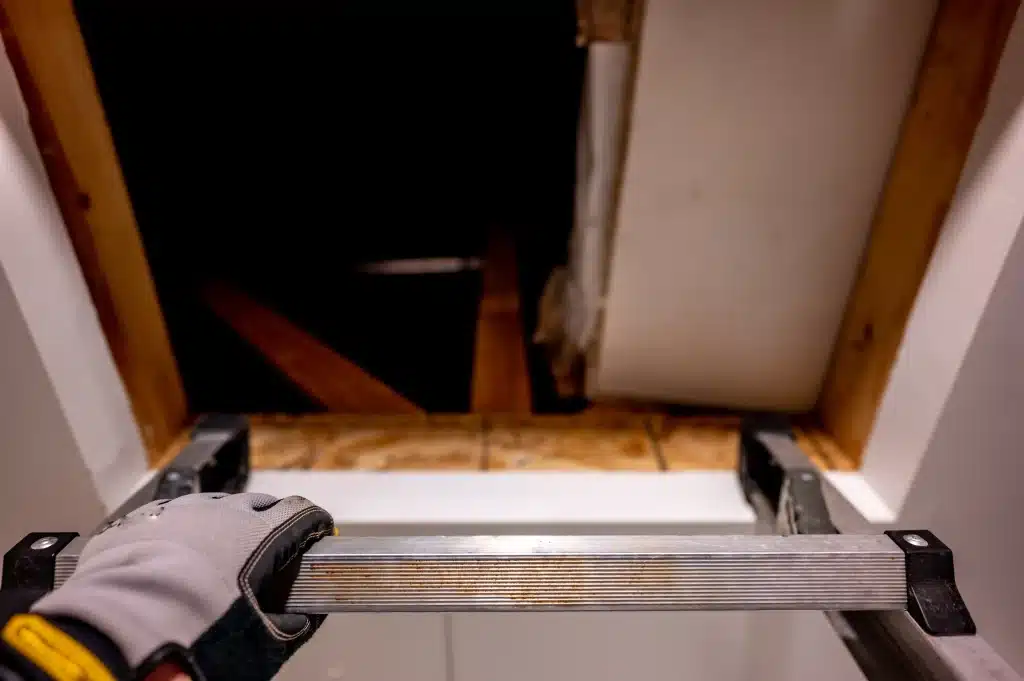
The inspection contract excluded defects hidden behind walls, floors or ceilings — “This includes …insulation that [is] hidden or inaccessible” (para. 46) — and no invasive testing was required. The report recorded that the attic was inspected “from access hatch,” identified glass fibre at R-50, and listed wall insulation as “not visible.” The inspector opened the hatch, looked with a flashlight and dug into the insulation by hand near the hatch without entering the attic — a search “similar, if not identical” to the 2013 inspector’s, with no evidence of any other standard for building inspectors (para. 45).
According to the CAHPI standards of practice, that was enough. The standards require an inspector to report the presence of vermiculite if found, but Reid J. held they impose no duty to report its absence (para. 52), and inspectors are not required to disturb insulation. No breach of contract, no negligence (para. 54).
The inspector lost on something else. MDHI’s website described its inspectors as “certified” and one principal as a “Certified National Home Inspector.” The inspector who attended held a diploma from a home inspection school. There was no evidence that he, his partner, or the business was certified by any entity, and MDHI was no longer a member of CAHPI. Home inspection is not a regulated profession in Ontario.
Holding a diploma is not a certification, which implies approval by a supervising entity. Being a former voluntary member of an association likewise is not a certification. (para. 57)
Negligent misrepresentation was made out. But the remedy followed the loss the misrepresentation caused, not the loss from the vermiculite:
There is no link between the misrepresentation and the loss suffered by the Mettis flowing from the presence of vermiculite. As a result, the only damages to which the Mettis are entitled is a return of the fees paid for the report. (para. 59)
Judgment went for $497.20 plus prejudgment interest. Reid J. assessed damages provisionally at $52,293.38 had anyone been liable for the vermiculite, about 38 per cent below the $84,732.04 claimed.
Key takeaways for transactional counsel
- Tell purchaser clients what the inspection contract excludes before they rely on it. Hidden insulation and anything behind sealed walls were outside this contract, and no invasive testing was required.
- Check the inspector’s credentials when the client is choosing one. Home inspection is unregulated in Ontario, and “certified” here meant a school diploma and at most a former voluntary membership.
- Explain that suing the inspector recovers the inspector’s wrong, not the defect. A misrepresentation unconnected to the loss was worth the inspection fee.
- Find the inspection report from the vendor’s own purchase. The 2013 report finding fibreglass and no vermiculite closed off the inference that these vendors learned of it when they bought.
- Advise vendor clients that liability turns on actual knowledge, concealment, or reckless disregard, and that none was proven here. These vendors had no duty to investigate the attic after a leak or to canvass tenants.
- Tell clients to allocate remediation invoices as they go. About $23,700 of the $32,400 cut came from electrical and renovation accounts that mixed remediation with work that was conceded, unrelated, or never broken down. The rest fell on betterment, unproven or pre-discovery invoices, and an unaffected basement unit (paras. 63–69).
