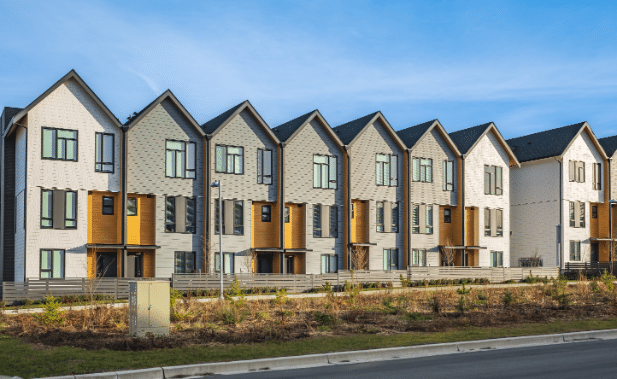
Closing adjustments on a new build arrive late, in a lump, and with no realistic opportunity to argue. Bellisario et al v. 2200 Bromsgrove Development Inc., 2026 ONSC 4050, released July 10, 2026, is what happens when a large group of purchasers declines to accept that. The developer was ordered to repay $1,295,422.15, plus interest, plus substantial indemnity costs.
The clause, and what it did not cover
The applicants bought units in Clarkson Urban Towns in Mississauga. Section 4.01(c)(iv) of Appendix A to their agreements of purchase and sale permitted the developer to charge two things: under subparagraph (A), the cost of installing a water, hydro and gas meter in each unit, including the installation and connection charge for that particular unit meter; and under subparagraph (B), each purchaser’s proportionate share of all “electricity, gas, water sanitary, drain and sewer infrastructure, installation, connection and energization costs (or security relating thereto) actually paid by the Developer to or deposited by the Developer with the City of Mississauga or utility service provider.”
In reasons released April 25, 2025, Papageorgiou J. held those provisions did not entitle the developer to pass along construction costs paid to its own trades and construction workers for infrastructure work. The developer had nonetheless given purchasers packets purporting to pass along payments to third-party contractors and trades, amounts paid to Metrolinx, “procurement charges,” and the cost of a safety barrier. It also could not charge the $800 fee levied to extend a closing date.
The court could not determine what, if anything, had lawfully been charged, because the developer had refused to answer questions on cross-examination about what it actually paid. An accounting and a reference under r. 54.02 followed — a reference the court observed would have been unnecessary had the questions simply been answered.
The accounting that proved nothing
The accounting stage went no better. Volume I of the developer’s materials contained invoices from the City of Mississauga, the Region of Peel and Alectra. Volume II contained invoices from contractors, trades and other third parties — precisely the category already ruled irrecoverable.
When examined, the developer refused to answer proper questions, refused undertakings, and refused to say what informed the production. The court drew an adverse inference. The developer then failed to deliver written submissions, and advised two weeks before the hearing that it would not attend. The hearing proceeded unopposed.
On subparagraph (A), the developer’s representative testified he did not know whether the company had tracked the cost of installing meters in each unit, and confirmed the work was done in bulk with no individual cost per unit. Undertakings to identify supporting documents went unanswered. On subparagraph (B), the materials disclosed a Planning Act application fee of $16,381.44, on which the developer undertook to say what it was for and whether it had been passed on to purchasers, and never answered. It did confirm that a site plan letter of credit of $168,299.40 had been passed on, but led no evidence that the underlying site works related to electricity, gas, water, sanitary, drain or sewer infrastructure at all. Region of Peel charges were not permitted charges to begin with, and the Alectra invoices related to construction-period energy consumption and temporary power rather than to installing utility infrastructure.
The conclusion was inevitable:
The Developer has not produced documents and/or shown that the documents it did produce support charges that could be levied by way of adjustment pursuant to ss. 4.01(c)(iv)(A) & (B). (para. 42)
Costs on a substantial indemnity basis
Substantial indemnity costs remain “rare and exceptional.” The court awarded them at $24,734.80, listing the developer’s conduct item by item: an accounting required only because it had refused to answer questions in the first place; materials that continued to include charges already ruled out; a missed timetable; unanswered undertakings; and notice of non-attendance given two weeks before a hearing everyone else had prepared for.
For your file
The drafting lesson is the plain one. An adjustment clause is a ceiling, and it will be read against the developer. Language limited to amounts “actually paid to or deposited with” a municipality or utility does not reach the vendor’s own construction costs, however the vendor characterises them. If you act for a builder, say what you mean; if you act for a purchaser, read subparagraph by subparagraph and price the exposure at the review stage rather than on closing day.
The procedural lesson matters just as much. These purchasers recovered because they asked, early and specifically, what the developer had actually paid — and the refusal to answer became the case. On a new build closing, a short letter requesting back-up invoices for each adjustment, and payment made under protest with an express reservation of rights, costs almost nothing and preserves everything. An adjustment clause that conditions payment on production of supporting invoices is better still.
Finally, note the timeline. Prejudgment interest on the recovered adjustments runs from July 20, 2022; judgment came in July 2026. Purchasers who close and fight afterwards need to understand that the money comes back slowly, if it comes back at all.
